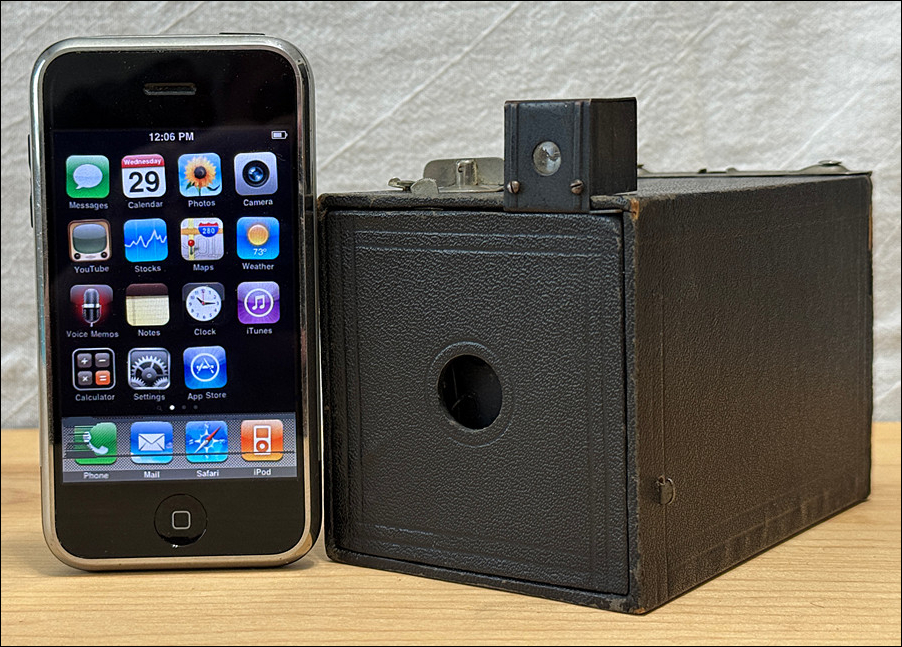
 The two most disruptive cameras in the history of photography… the original Apple iPhone (2007) and the Kodak Brownie camera (1900) shown here with the optional viewfinder clipped to the front.
When the wet plate photography process, Kodak’s Brownie camera and Apple’s iPhone were introduced each fundamentally and broadly disrupted photography’s accepted sensibilities and sent it on a course moving through industrialization, democratization, normalization and finally to integration, fundamentally changing both the medium and our understanding of it.
Frederick Scott Archer published his wet plate collodion photography process in 1851 and, in the three years that followed, a complete photography infrastructure with equipment manufacturers, itinerant photographers, studio photographers, chemical suppliers, retailers, and even commercial labs developed. Although concentrated primarily in major metropolitan centers, photographers in smaller towns and rural areas were served by a burgeoning catalog system that could deliver anything needed.
The wet plate’s impact was instant, global and endured for more than 150 years, ending only with the public’s overwhelming embrace of digital photography in the mid 2000s. Archer’s process disrupted the very core of photography, producing significantly sharper photographs than the paper-based calotype process.
Literally everything that followed film-wise is entwined in Archer’s legacy. Celluloid sheets replaced glass plates... roll film replaced celluloid sheets... then 35mm and 110 film dominated… whether black and white, color negative or slide film… even the “instant picture” systems were descendants of Archer’s process.
A further disruptive impact of the wet plate process was its reproducibility.
Photography was no longer a “one-and-done deal” like the metal-plate daguerreotypes or fading-prone calotypes. Although the glass plate had to stay “wet” during exposure and processing, the negative, once dried, was permanent. A lab technician could make as many prints as the customer wanted, now or at some point in an undefined future. The prints could be made quickly and economically.
Archer’s wet plate process opened photography to a variety of uses... (these are in no particular order and this list is certainly not complete!) Tiny prints of loved ones were placed in lockets, brooches, and on memorial cards. People handed out calling cards with small photos pasted on. Early photojournalists sold prints of wars and public events. Businesses started using photos in advertising and promotion. Tourists bought photo albums of visited scenes and landmarks to take home with them. Doctors and scientists photographed patient conditions and experiments. Archaeologists and anthropologists documented their work. Engineers used photos to track construction. Some photographers delved into fine art. Families commissioned postmortem portraits as keepsakes.
In short, Archer’s wet plate process allowed photography to evolve into a tool of science, commerce, education, art and mass communication.
All went swimmingly... until 1900.
In February of that year Kodak released the Brownie camera and greatly expanded the photographic infrastructure.
 While it is impossible to say with certainty whether this photograph was taken using a Brownie camera, it is representative of the photographic quality available during the early “Brownie era”.
The Brownie was a marvel of minimal design. At just three inches square by five inches deep it fit well even in a child’s hands. It was equally light weight, tipping the scales at just 10 ounces. It had no controls of any kind save a lever to operate the shutter and a pull-out switch to allow for time exposure. Users could load and unload rolls of six-exposure #117 film themselves. The camera had a simple lens structure and a simple rotary shutter. There was no built-in viewfinder, although one could bought and clipped on.
But here is the twist... when Kodak designed the camera it was originally intended for children. Not long after its release Kodak discovered adults were buying it for use as a family camera. Marketing changed and the Brownie camera became a popular household staple.
There were several precursors to the Brownie.
The conceptual precursor was the 1883 Schmid “Detective Camera” which proved there was a market for a portable, “inconspicuous” camera that didn't need a tripod. It defined the very essence and concept of the "hand camera."
Kodak’s first attempt at producing a “hand camera” was the 1886 Eastman-Cossitt “Detective Camera” which was a commercial failure being far too complicated for most people to operate. This was followed by the 1888 Kodak camera which was much simpler to operate. The camera had limited success but it was far too expensive for mass appeal.
The Brownie followed. It was designed to be a point and shoot camera that would be as inexpensive as possible. And it was. The whole camera cost $1.00. A six exposure roll of film ran 17¢ and processing the six exposures cost 25¢. The camera sold like hotcakes.
The Kodak and Brownie cameras are generally credited with “democratizing” photography simply by their reach but it was the Brownie that normalized photography as a family and personal activity. Mom and Dad could now take pictures of Junior or Sis’s eighth birthday, take the film to the local processor – generally the local camera store – and have all the prints needed for family members who weren’t able to attend. They could take their own photos of the places where they vacationed and take the rolls of film to the camera store when they returned home. They could take their own photos of family gatherings, take the film to the camera store for processing, and have prints made for family members as a remembrance.
Photography became an intimate and personal activity with seemingly unending uses, fostering a growing visual literacy and visual culture.
Another area of major impact was the hobbyist market where the photographer could shoot his or her photographs and then process and print the exposures themselves. This ability was a major factor in partially collapsing the barrier between the professional and amateur photographer.
Very quickly, the Brownie camera became ubiquitous as did the numerous derivations that followed from Kodak and other manufacturers.
All went swimmingly... until 2007.
At about 10:28 AM on Jan. 9, 2007, during his keynote address at the annual Macworld Conference & Expo in San Francisco, Apple’s Steve Jobs began the process of dismantling 152 years of photography infrastructure with just sixteen words - "These are not three separate devices. This is one device. And we are calling it iPhone."
With Jobs’s announcement the camera went from being a useful and well-used imaging appliance to an instrument of instant communication, ubiquitous documentation and for many, a tool of absolute daily necessity.
While the Brownie promised to put photography in the hands of the masses, the iPhone made it happen in a way that was never imagined in 1900. The iPhone was not simply a new camera, it was a totally new approach to the practice of photography for the majority of people.
In all fairness, the original iPhone camera was nothing to write home about. It was a basic point and shoot... the 2007 version of the Brownie.
The camera was a fixed focal length and a fixed-focus system with a minimum focusing distance of about two feet. It featured a 2-megapixel sensor behind a 4-element lens, a fixed f/2.8 aperture with shutter speeds ranging from 1/15 to 1/1000 of a second. There was no autofocus, no flash, no video and no manual control of any kind.
The processing software was a rigid, preset pipeline. All the color balance, tonal mapping, and sharpening were baked in with rudimentary algorithms and applied in a fixed order. In good lighting, results were comparable to entry-level compact cameras. In lower light, however, performance dropped off a bit - noise increased, some detail was lost and tonal range narrowed.
But the iPhone camera didn’t have to be great in pure photographic terms. It needed to be always on, always with you, always ready and "be good enough”.
 A daylight photograph taken with an original iPhone camera on 10/28/2025. This photograph falls well within the bounds of “good enough”.
 A normal-room-light photograph taken with an original iPhone camera on 10/28/2025. While there is considerable noise, softening of sharpness and reduced contrast in the photograph, it falls within the bounds of “good enough” for many.
The capstone of iPhone’s disruption was connectivity. Having photographs on your phone was one thing but being able to get them to other people without using another device was the key.
There were three ways to transfer photographs from the original iPhone.
First, the user could move photographs by direct connection. Plug the phone into a computer using the supplied cable, and the device would appear as an external drive. From there, photos could be moved into folders or imported via iPhoto (Mac) or Windows Explorer. This was tactile and reliable but certainly not the connectivity Apple advertised.
Second, users could sync the phone to their computer using iTunes. This worked with either a Mac or a Windows machine. Photos could be uploaded from the phone to the iTunes library and then downloaded to the computer. It was technically wireless transfer but again, not quite the seamless experience Apple had promised.
Third, and most disruptive, was connectivity using email. From the phone itself, users could send photographs to anyone with an email address. Granted, only one photo could be sent at a time, and the EDGE network was slow, but this was a first. The iPhone collapsed the distance between exposure and communication. A popular refrain from the time captured the advertised magic... “sending a photo from an iPhone is as simple as sending a thought”.
In this element of Apple’s disruption, the iPhone didn’t just change the tools, it changed the custom and practice. The image became a message and the camera became a communicator.
The Brownie disrupted the who of photography, democratizing who could afford it, who could do it and who got to be seen. The iPhone continued the Brownie’s legacy but also disrupted the why. No longer was photography about preserving memory or crafting art. It became a language of presence, proof, and participation. A meal, a wedding, a sunset, holding hands, a new car, the waves lapping the beach… anything from the most trivial to the most significant was an open subject for someone with an iPhone.
The camera became a node in a network with the photographer as the creator, sysop and transmitter. It was this integration of camera and phone that was the ultimate disruption. The infrastructure that supported the making of images was now irrelevant to many. In its place was a new ecosystem that ultimately led to cloud storage, social feeds, algorithmic curation, neural processing and, for some, the adulation of likes and shares.
The iPhone’s impact was immediate, far reaching and seemed truly disruptive at the time. No one realized how extensive it would become in a comparatively slow build over the next 12 to 15 years.
In the twenty four months after Jobs’s announcement, the smartphone camera market exploded. Google’s Android operating system was adopted by the majority of smartphone manufacturers and nearly all smartphones featured cameras ranging from 2mp to 5 mp. Some were already offering autofocus and flash.
By 2013, six years after Jobs’s announcement, the dominance of smartphone cameras was clear. Industry data showed smartphones accounted for the majority of consumer photography and compact camera sales began a steep decline. While exact numbers varied widely by source, this is generally accepted as the definitive crossover period.
The first “uncontested-hard-data” tipping point in the smartphone camera’s photographic disruption came in 2016 when information from a variety of sources including photo-sharing platforms like Flickr showed smartphones had become the most-used device for uploaded images, surpassing both dSLR and compact cameras. Smartphone cameras represented 50% of all photographs taken. Traditional cameras accounted for 45%. Other imaging sources represented the remaining 5%.
By 2022, 15 years after Steve Jobs made the fateful announcement, the disruption of the traditional photography infrastructure was clear and irreversible. Smartphone cameras were used in making 85% of all photographs world wide. Discrete cameras were used for 10% of the photographs made while other sources held firm at 5%.
And still, photo quality was never the prime determinant. From the original iPhone camera on, your “phone” was always with you and it was always on. It was simple to operate. Pull it out of your pocket or purse, open the camera app, tap the shutter button and you have a “good enough” photograph. No waiting for it to start like with a traditional camera, no meters to read, no histograms to adjust, no dials to twirl, no rings to twist, no leavers to flip.
As the cameras grew in capabilities with advanced image processing and multiple cameras of differing focal lengths, by 2018 the photographic quality grew from “good enough” to exceptional and then, a few years later, to world class.
By 2022 the smartphone camera became integral to modern life. It was no longer simply an imaging device - it was a universally accepted cultural implement and universally essentially “infrastructural”. With the smartphone camera, photography became a universal visual language with all of the implications that brings. What began as a disruption in 2007 became the norm 15 years later And continues so to this date.
The wet plate process, the Brownie camera and the iPhone are the three disruptions that forever changed photography. Of these, the iPhone is the most serious, precisely because the infrastructure built around the wet plate and the Brownie had become so deeply entrenched.
Some would argue the shift to digital photography was as disruptive as anything else. That claim might have some traction but not for long as digital’s impact was more grandly evolutionary than revolutionary. This shift replaced film with the digital sensor and related electronics but that is all that fundamentally changed. The core infrastructure is still intact. We still have the suppliers and retailers, we still have all of the user-adjustable camera settings from the film era and we’ve even added a few more. Software, with all of the available presets and tunings, replaced the commercial lab. Studios persist and there are still itinerant photographers. We even call the preferred digital format “the digital negative”. And most importantly to the preservation of the infrastructure of the traditional digital realm, we still need multiple devices to ultimately produce a usable photograph.
To predict where this disruption will ultimately lead would be astonishingly presumptuous but…
The one thing overwhelmingly clear since that fateful day in 2007 when the iPhone launched is that the photography universe has been organically dividing into two distinct realms, traditional photography and smartphone photography.
The traditional photographic infrastructure continues to purse photographic purity in a number of ways… being able to select the right camera body for a specific genre, being able to select the right lens for a specific subject, having the “correct” filter to adjust the tone or exposure of the image, having the most advanced software package to process the camera raw file. All of this hardware is geared to producing the “perfect” photograph while “working within everyone’s budget”.
The infrastructure continues to produce “training” materials in social media posts, public-facing photography blogs and photographer’s websites advocating traditional manual exposure control and learning the variety of in-camera tools used in that process.
And then there are the never-ending accessories, the tripods and monopods, the flash units, the lights, the modifiers, the bags and cases, the straps, and more... ad infinitum, ad nauseam.
The evolutionary versus revolutionary reality is quite different in the software realm as the infrastructure continues to rely on software developers to “step up the game” both in-camera, continuing to add user initiated options to the increasingly complex menu structures, and in the software used for processing the once unloaded camera raw files.
“Training” materials advocate the use of a variety of tools in software packages to compensate for deficiencies in composition, exposure or color balance. AI assisted masks, gradients, object removal, etc. And then there are the AI assisted culling packages. This does not begin to address the fledgling designs including generative processing for everything from sky replacement to adding or moving objects in the frame.
Beyond the hardware and software of the traditional infrastructure is the traditional ritual associated with photography. It may be developing the “shot list” either on paper or simply as a thought process. Next is figuring out what equipment is going to be required for “the shoot”, checking the batteries and the media cards and then loading it all in the camera bag and making sure the “just in case” stuff is there.
Or it could be as simple as picking up the camera, checking the battery and media card and putting it in the small belt case.
After either, the next part of the ritual is heading out. Afterword there are the rituals of unloading the files, culling for the best shots and then processing the photographs.
All of this in the name of photographic purity.
Smartphone photography moves beyond the confines of the traditional photography infrastructure, creating something far more complex and almost organic - smartphone photography is defined by its ecosystem.
In sharp contrast to traditional photography’s infrastructure with its expansive multiple independent nodes, smartphone photography is a compact vertical ecosystem that compresses exposure, processing, formatting, output and distribution into a single device that gives the user a perfectly finished photograph ready for any application.
There is no pause between exposure and circulation. The steps are no longer sequential but simultaneous meaning the seams and the friction that once the defined photographic practice are gone.
The seams that existed in traditional photography have been erased. There is no more transferring the photograph from one device to another. In the smartphone system the photograph is exposed, published, archived, and ready to distribute practically instantaneously.
This seamlessness is part of the disruption dating from the original iPhone and it changes the very nature of photographic practice when photography had visible joints. The practice involved the careful exposure of the scene, the editing, the posting and the printing. Now all of those joints are handled in the device’s ecosystem which is why the vast majority of smartphone photographs are produced using the standard “Photo” app and the touch screen biasing. The technical aspects of creating the photograph seem effortless.
The frictionless aspect of smartphone photography functions at two separate but complementary levels shifting photography’s cultural role from that of a specialized craft to a universal language of presence.
The first friction elimination point being at the device level. With the release of such smartphones as the iPhone 13 Pro/Pro Max, the Google Pixel 6 Pro, the Samsung Galaxy s21 Ultra and the Sony Xperia 1 III the smartphone became a complete photography platform unto itself. There were no other devices needed for these cameras to function well in 90% of all photographic situations.
Various manufacturers have tried to accessorize smartphone cameras with everything from third party photo apps through continuously burning LED light panels to ergonomic handles. This is an attempt to draw smartphone photography into the traditional horizontal infrastructure. Aside from a basic protective case, the vast majority of smartphone cameras are not accessorized.
And the answer is really astonishingly obvious… the vast majority of users want to be able to simply “pull their phone out and take the picture” and in that regard, the pure, plain, unadorned smartphone camera is the most capable.
The second part of the smartphone camera eliminating photographic friction is in its integration into everyday life. The camera is no longer a discrete device and the photographs are no longer discrete artifacts. The act of photographing is a seamless extension of gesture that both allows and encourages instantaneous communication.
With no frictional resistance between intention and output and then between output and distribution, photography is now more about the narrative and the presence. It is about immediacy.
But this shift to immediacy does not preclude intention in any way. The photographer continues to be the one deciding on the intention of the photograph. This can be the immediacy of the moment or the rendering of the long-studied scene. The smartphone camera makes both equally available. Immediacy no longer excludes intention… it simply relocates it, front loading the process. The photographer’s choices shift from managing technical thresholds to shaping narrative presence.
The combined collapse of the seams and elimination of friction is not just a technical disruption but one of understanding as well, forcing us to consider whether photography should be preserved as a heritage craft, be embraced as a hybrid practice, or moved forward into post-disciplinary storytelling.
All of the articles on this website are contained in the downloadable white paper "Operationalizing the Language of Photography for Effective Storytelling". To download the paper, click here.