That mining towns in the western United States often led a rapid boom to bust existence is not remarkable. After ore was discovered and a mining claim filed, a camp appeared almost immediately. If the mine’s production was good, the camp quickly grew into a small town and, if the mine kept producing, the small town boomed. But when the price of ore fell, the veins ran out or something else closed the mine, the towns often disappeared as fast as they came into existence.
In the early 20th century, the towns of Gleeson, Courtland and Pearce, AZ, were booming with the discovery of gold, silver and copper. At the height of the boom the three communities had an estimated population of almost 4000. But then, for each community, came the bust...
Pearce was the only one of the three to survive, almost becoming a ghost town.
Pearce came into existence after prospector James Pearce discovered gold and silver in 1894. The Commonwealth Mine was established and the boom was on. Two years later the general store opened and a U.S. Post Office was established. A railway station and rail service followed in 1903. Pearce became a fairly large town for the area, attracting families and businesses from as far as Tombstone. One major difference between Pearce and other mining communities was the location of the mine. Often the mine and town were integrated on one site but the mine at Pearce was actually located about a mile to the east in an area that came to be known as Fittsburg. The distance may have helped it survive the coming bust. A 1904 cave-in closed the mine but it seemed that Pearce had become self-sustaining.
By 1919, Pearce had a population of approximately 1,500 and boasted a school, restaurants and bars, boarding houses and hotels, and a motion picture theater among other businesses. Pearce proved to be the town of hotels. Pearce’s wife cornered the market early by convincing the local Chamber of Commerce to give her the exclusive right to open and operate all of the town’s hotels and boarding houses which she did with abandon. Pearce went into decline in the mid 1930’s as the Great Depression ravaged the nation. The railroads pulled up their tracks and the exodus was underway. The population dwindled to under 120. Today, Pearce, and three surrounding communities have rebounded with a combined population of almost 2,000 and are promoting the area as a retirement destination. Courtland and Gleeson weren’t as lucky as Pearce.
When copper was discovered in the Dragoon Mountains, it seemed to be the find of the century. The strike was thought to be so big that in 1908 and 1909, four companies began mining the area. All the mining activity attracted hundreds of settlers and Courtland was established as a large tent city within a few months.
The growth was so explosive that two railroads provided service to the town almost immediately. In 1909, not a year after the discovery, the Courtland Post Office opened and the Courtland Arizonian newspaper printed its first edition. The tent city quickly gave way to houses, churches and businesses. At its height, Courtland had a population of approximately 2,000. A Chamber of Commerce was formed in 1911. One of the chamber’s first concerns was the availability of water to the community.
Generally speaking, what has come to be known as ‘public works’ wasn’t a major concern in mining towns. Not so in Courtland. Within months, the Courtland Water and Ice Company was formed and laid five miles of water service lines making the modern convenience of running water available to most of the town. Courtland boasted a small hospital, a car dealership, numerous restaurants and bars, an ice cream parlor, a motion picture theater, a full sized baseball field, a horse racing track and, at its peak, two newspapers. Courtland also boasted an impressive nightlife, making it the place ‘where the action was’.
Then there was the Courtland Jail. Popularly called the Brite Hotel after Sheriff Tom Brite, it was considered by many the best place in town to spend the night. The jail was built of steel and reinforced concrete. It had two large cells, each complete with toilet and sink. It also had a small office for the sheriff’s deputy. This facility replaced the original jail which was simply the unused part of a mine that had a heavy door installed. Because of the spacious conditions and running water (most miners lived in small shacks or tents on the outskirts of town), many found the thought of spending a night or two in jail appealing and it was almost immediately overcrowded. The town court created a work credit program that allowed prisoners to reduce their sentence in exchange for road work but a number of prisoners chose to stay in jail rather than work. This left the town short of road workers and the county with a huge food bill for the prisoners.
The Brite Hotel wasn’t used after 1916 as a regional jail was opened and, in 1938, the gates and barred windows were recycled for use in the new county jail in Benson. The boom that was Courtland, however, quickly turned to bust. What was thought to be a huge copper strike ran out in 1917. As profits from the mines began to shrink the mass exodus began. The post office, which marked the town’s arrival, closed in 1942. It is still unclear why the post office remained open so long after the town essentially closed.
Just down the road from Courtland was Gleeson.
Gleeson wasn’t always known as Gleeson and where Gleeson is now isn’t where Gleeson always was but mining was always part of the town. Small-scale turquoise mining was done in the Dragoon Mountains since at least 1870, mostly by Native Americans who established a camp called Turquoise Mountain around the mine site. In 1890 Tiffany & Co. bought the mines. The camp grew into a small town called Turquoise. A post office was opened and the town maintained itself until Tiffany pulled out in 1894. The post office was closed and the town floundered.
In 1896 John Gleeson, a miner from Pearce, investigated the area and found copper. Gleeson filed a claim and opened the Copper Belle Mine. Production was good but the water necessary for mining was in short supply. Gleeson moved the operation closer to an adequate water supply and re-named the town Gleeson. The Gleeson Post Office was established in 1900 putting the town on the map. The town grew and featured a number of businesses and services including a general store, a saloon, a small hospital, a physician’s office, a jail and a school. A fire in 1912 burned 28 of the town’s buildings. This could have been the death of the town but, as the mines kept producing, the town was quickly rebuilt. During World War I the need for copper soared and production boomed.
While Pearce was the town of boarding houses and Courtland was ‘where the action was’, Gleeson, it seemed, was more of a family-friendly place. The town’s school simply could not keep pace with the number of kids. The town started with a small school which it soon outgrew. They built a second school but it soon became cramped and overcrowded. In 1917 the town built ‘the big school’ which was finally large enough to meet it’s burgeoning needs.
Gleeson survived several fires and the 1918 influenza outbreak but it could not survive the combination of the copper ore playing out and the Great Depression. Unlike Courtland which declined in the 1920’s, Gleeson lasted well into the 1930’s. But like Courtland, the town had not diversified enough to become self sustaining as most of the 500 residents depended on copper mining and moved on when the mines closed. The post office closed in 1939. A handful of people still live in the Gleeson area although the town site itself is not inhabited.
The boom and bust cycles for mining towns continued throughout the West. In some cases, the towns became ghost towns like Gleeson and Courtland. In some cases they survived to this day but as small communities like Chloride, AZ, or Searchlight, NV, with populations in the hundreds. Then there are the cities that not only survived the boom and bust cycle but thrived. Placerville, CA, and Butte, MT, are examples of communities that started as mining camps and grew to become diversified cities with populations in the thousands.
But it always has to be acknowledged that the towns like Pearce, Courtland and Gleeson are part of our heritage.
The Photographs
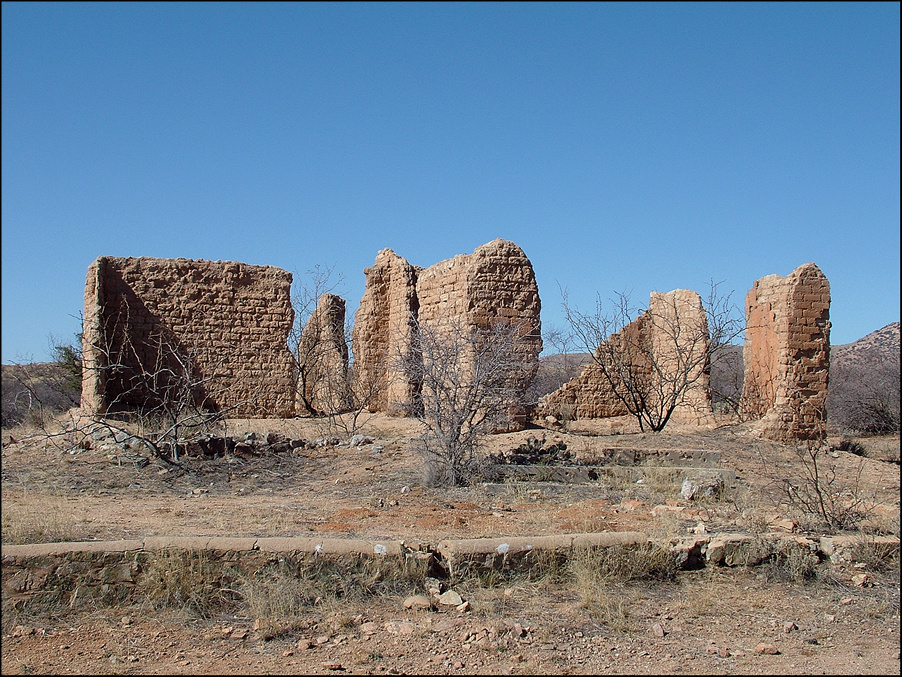
Ruins of an abandoned home in Gleeson, AZ.

Detail of the adobe brick construction that was common to the area.

The foundation of what appears to be the Gleeson, AZ, hospital.

The Joe Bono saloon and general store in Gleeson, AZ.
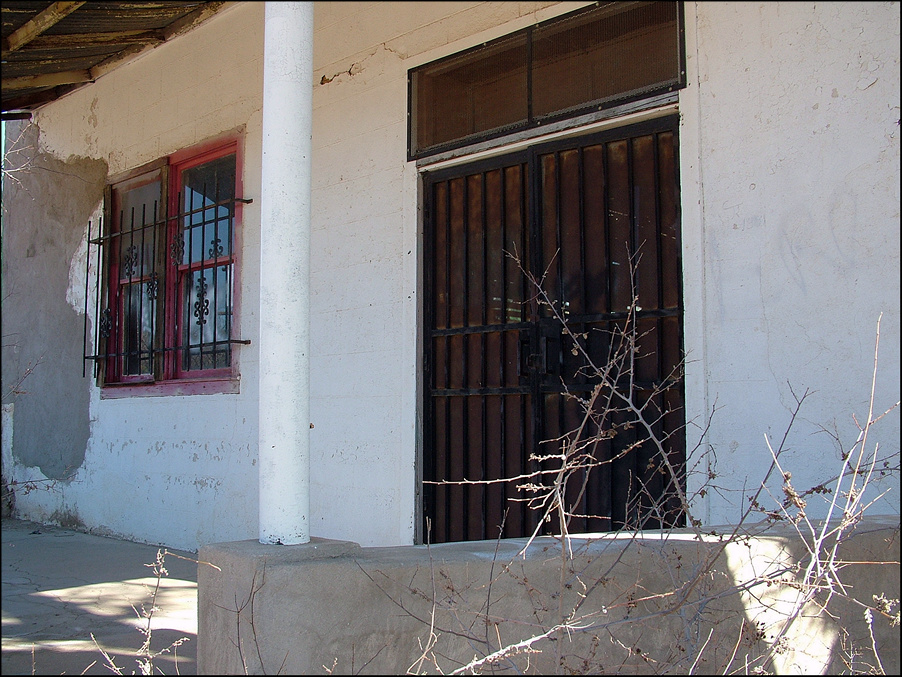
Detail of the barred front door and window of the Joe Bono saloon.

The foundation of ‘the big school’ in Gleeson, AZ., the last of the three schools the town built.

Detail of the foundation of the third and last Gleeson School.

This unidentified building, possibly a hotel, is one of three left in Courtland, AZ.

Interior view of unidentified building in Courtland, AZ.

The deteriorating shell of the Courtland General Store. This view is actually from the rear of the store.

Courtland's "new" jail, built of reinforced concrete and last used in 1916, has been heavily graffitied.

Rear view of the "new" Courtland jail which was built in 1909.
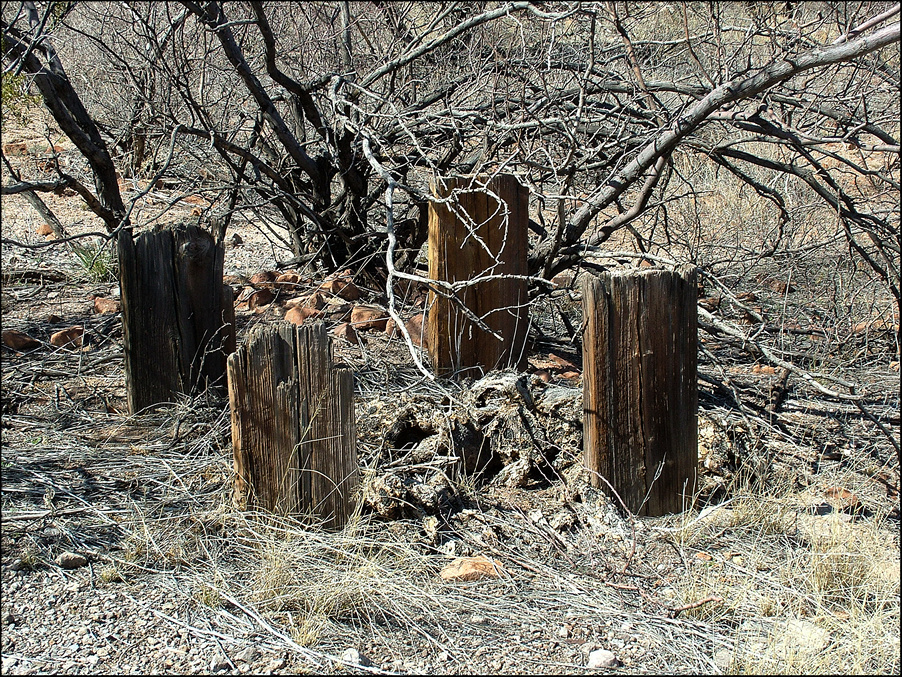
What appear to be wooden grave markers in a small cemetery in Courtland, AZ.

Remains of an unknown structure in Courtland, AZ.

The purpose of this single-room concrete structure outside Pearce, AZ, is unknown.

This miner’s shack in Pearce, AZ, is unusual because of its wood construction.

A more conventional adobe brick miner’s shack in Pearce, AZ.

Detail of the miner’s shack showing that the mortar has outlasted the adobe brick used.
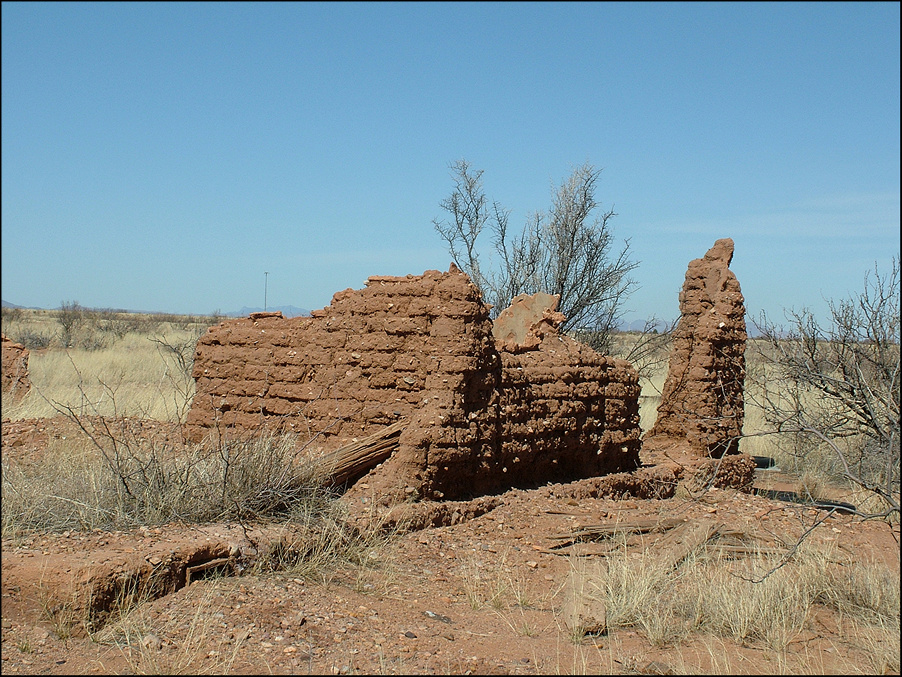
Ruins of an adobe house, Pearce, AZ.

Ruins of what appears to be a duplex outside of Pearce, AZ.

Detail of ruins of duplex outside of Pearce, AZ.