----- The Disruptive Cameras -----
Photography has always been shaped, at least in part, by technology. Somebody comes up with a better way to make a picture, and suddenly the way we do things shifts. Sometimes the change is big, sometimes it’s barely noticeable. But four truly groundbreaking advances stand apart. These weren’t simply “improvements”, these advances fundamentally changed how we think about photography, how we use it, and how the whole system works.
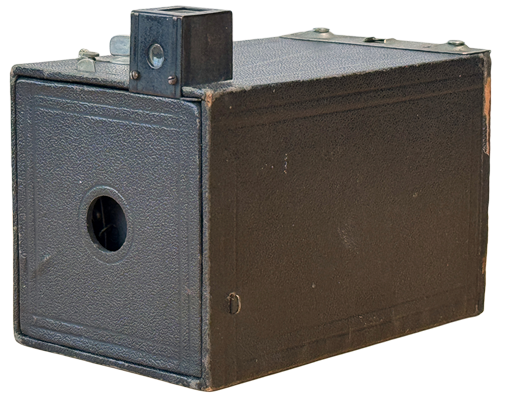
The Kodak Brownie (1900 – 1915)
This is the camera that truly democratized photography and turned it into a family event. Before the Brownie, photography was limited to highly skilled professionals. The Brownie collapsed that distance and radically changed who could take pictures and what pictures could be taken. The camera was simple to operate. Keeping the sun over your right shoulder, you would point it at your subject and trip the lever. You could now take pictures of Junior with the big fish he caught, Sis riding her new bicycle or Mom and Dad with the new, family-size buggy. At just $1.00 (about $38.00 in 2025) the camera, which was made of rigid pasteboard rather than metal keeping cost down, was affordable and, with the user being able to change rolls of film themselves, it met the needs of convenience and, for the day, availability. Shortly after its release, the Brownie dominated the photography scene and changed photography’s landscape forever. It made picture‑making ordinary, social, and an integral part of everyday life.
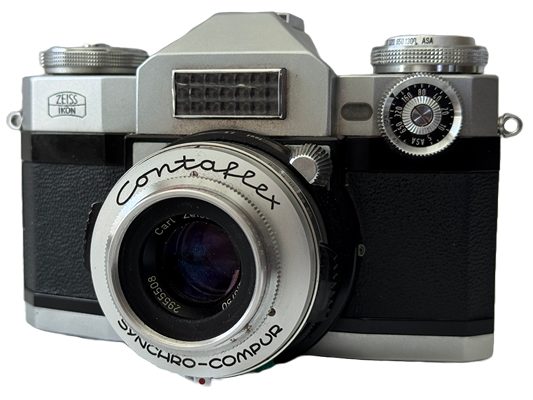
Zeiss‑Ikon Contaflex Super (1959)
The Zeiss‑Ikon Contaflex Super (1959) was one of the most quietly disruptive cameras ever built. It didn’t reshape the market, it didn’t become a household name, and it didn’t trigger an industry-wide shift overnight. Its significance comes from something more fundamental - it proved, for the first time, that a camera could “think mechanically”.
The Contaflex Super wasn’t the first camera to have a built‑in exposure meter, but it was the first to couple its meter with the camera’s exposure controls in a meaningful, coordinated way. It could evaluate the brightness of a scene, consider the film’s ISO, and mechanically guide the photographer toward the correct exposure by coupling shutter speed and aperture into a single, unified exposure value.
This coupling created a primitive but genuine form of auto‑exposure. When the photographer adjusted the shutter speed ring to center the match‑needle in the viewfinder, the camera automatically set the corresponding aperture. The meter didn’t just measure light — it actively participated in the exposure decision.
The camera’s leaf shutter added another advantage. It gave full flash synchronization at any shutter speed, something focal‑plane shutters of the era couldn’t match.
All of this happened without a battery. The selenium cell powered the meter, measured the light, and drove the mechanical logic that set the exposure. The Contaflex Super was a self‑contained, analog photographic computer disguised as a compact SLR.
It wasn’t loud, popular, or influential in its moment — but it was the camera that quietly demonstrated the future.
The camera’s mechanical logic directly foreshadowed the next generation of metered SLRs — cameras like the Pentax Spotmatic and the Mamiya‑Sekor TL, which took the idea of meter‑coupled exposure and carried it into the mainstream. The Contaflex Super didn’t win the popularity contest, but it quietly proved the concept that everyone else eventually adopted.
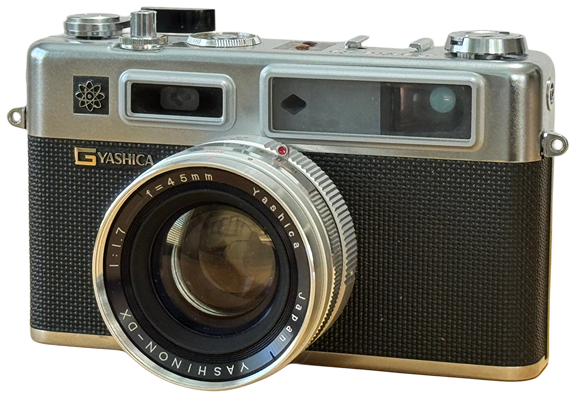
The Yashica Electro 35 (1966 - 1977)
Although not as overtly spectacular as the Brownie in its impact, the reach of Yashica Electro 35 is felt to this day. It was the next development step after the Zeiss‑Ikon Contaflex Super, being the camera that sparked the development of electronic exposure control and, more importantly, proved that such a system could be both reliable and dependable. The system, a fledgling aperture priority system, was continually refined during the camera’s production run and formed the basis of auto-exposure systems for years to come.
While the Electro 35 was the prototype for the “auto-everything” age, it was, more importantly, the unbreakable link between purely mechanical photography and the age of full electronic control that it foretold. The camera was an easy handling, dependable, fixed lens, rangefinder system and became widely popular with both amateur and professional photographers.
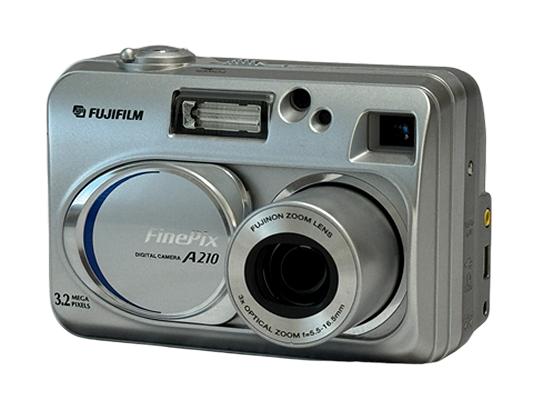
Compact Point and Shoot Digital Cameras (2003 - 2010)
In much the same way Kodak’s Brownie camera normalized photography in its day, the class of compact cameras represented by the Fuji FinePix A210 (2003) formed a “digital plateau", the moment when digital photography became "ordinary", replacing film. And it was just a year later, 2004, that "digital" became the default format for everyday photography. Affordably priced, simple, and built for families, cameras like the A210, along with Sony’s Cyber‑Shot and Canon’s PowerShot lines, turned the digital camera into a household appliance rather than a technological novelty.

Apple iPhone (2007)
In 2007, Steve Jobs ruptured photography’s entire infrastructure with the announcement of the iPhone. For the first time, the stages of photography collapsed into one uniform, consistent gesture. Exposure (renamed “capture” in the digital era), processing, distribution, and archiving were all contained in a single device. And if that wasn’t enough, it was pocketable giving users convenience, availability, and, crucially, connectivity.
The last device to come close to this level of impact was Kodak’s original Brownie. The iPhone wasn’t the first smartphone with a camera, but it was the first to let users send a picture anywhere in the world with just a few taps. The output wasn’t photographic-enthusiast perfection and low‑light performance was especially limited but perfection wasn’t the goal. The goal was to be good enough for most people, most of the time. (Perfection and world‑class quality would arrive sixteen years later.)
The impact was immediate. Within ten years, the iPhone and other camera‑equipped smartphones became the most widely used picture‑making devices on the planet. Just five years after that, they were responsible for more than 90% of all photographs made. The rupture of the traditional, horizontal photographic infrastructure and the shift to a unified, vertically integrated ecosystem was complete.

Samsung Galaxy S7
In the years following the iPhone’s release, the quality of smartphone photographs improved gradually, but public opinion remained stubbornly fixed: “phone cameras” were still seen as something between a toy and a novelty. Low‑light performance was the litmus test, and that barrier remained impenetrable.
Then, in 2016, Samsung released the Galaxy S7 and the entire anti‑smartphone objection regime collapsed. Its truly revolutionary Dual Pixel autofocus system opened low‑light performance, improved focusing speed, and, almost overnight, became the talk of the smartphone world.
But the real transformation was happening deep under the hood. The Galaxy S7 was the first mainstream implementation of what would soon be known as computational photography. It introduced early multi‑frame exposure and blending, along with rudimentary dynamic tone mapping, HDR, and noise reduction.
This early integrated algorithmic processing became the prototype for everything that followed. It raised image quality from “good enough” to just a tick below excellent. This was the moment when smartphone output surpassed compact cameras and began challenging entry‑level dSLR performance. This was when the smartphone stopped being “the camera you use when you don’t have a real one” and became the default camera for the world.
----- Other Collected Cameras -----
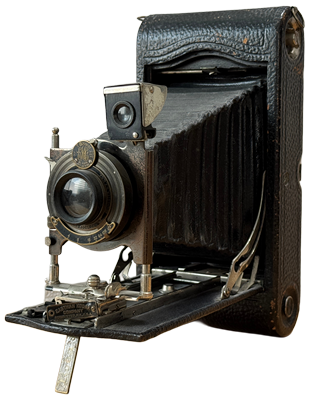
The Kodak No. 3A Folding Pocket Model C (1903 – 1915) was a “high end” amateur camera producing a larger negative which allowed the photographer to produce exceptionally high quality photographs. It was a versatile photography powerhouse being equally at home in the field or the studio. The Model C featured a rotating viewfinder, a high quality Bausch & Lomb Rapid Rectilinear lens and the “advanced” Kodak Ball Bearing shutter. It could be used either hand held or mounted on a tripod. It appears this camera is from the 1914 – 1915 production period. #122 roll film, $40.00 new (2025 price - $1,274.00)
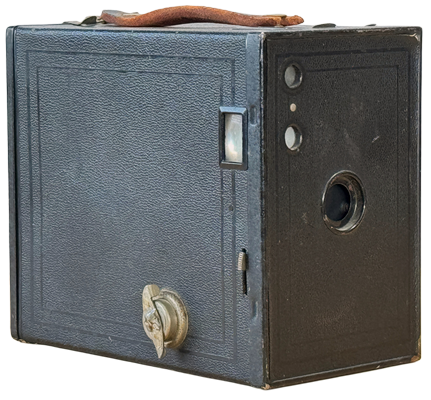
The Kodak No. 2A Brownie (1907 – 1936) was introduced in 1907 and remained in production until 1936. Early models had a pasteboard body, but in 1924, Kodak upgraded it to aluminum, making it more durable. This camera is a post-1924 model. #116 roll film, $3.75 new (2025 price - $71.00)
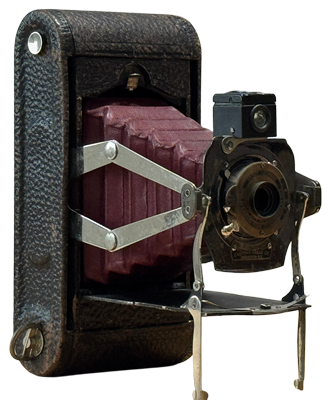
The No. 1A Folding Pocket Kodak (1899 – 1915) had a single reversible viewfinder, allowing for both portrait and landscape photographs. Some editions featured a coupled rangefinder, which was rare for cameras of this era, and the Kodak “Automatic” shutter. Kodak didn't always keep accurate records however, based on the serial number 150656, it appears this particular camera was made prior to 1910. #116 roll film, $13.50 new (2025 price - $421.00)
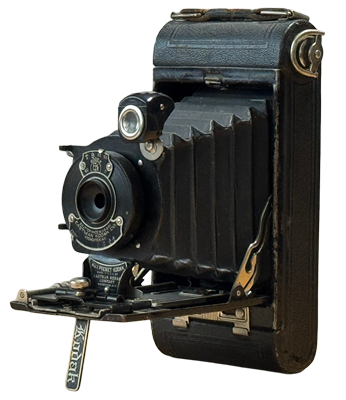
The No. 1 Kodak Junior (1914 – 1927) The camera was another attempt to scale the camera size and make it more "pocketable". The #120 film used by this camera is still widely used today in medium format film cameras. #120 roll film, $15.00 new (2025 price = $467.00)
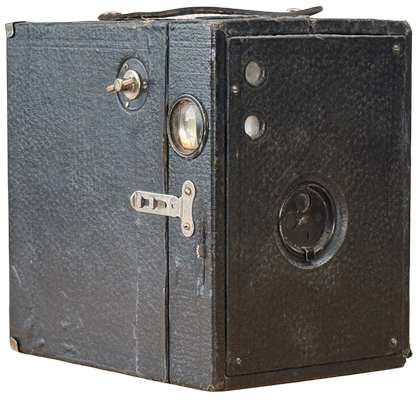
The Kewpie 3A camera (1915 – 1922), made by the Conley Camera Co. and sold through the Sears, Roebuck & Co. catalog, produced a photograph for use as a postcard. The camera was designed to be inexpensive, rugged, and easy to use. It was marketed as an affordable, large-negative camera for amateurs. #125 roll film, $5.95 new (est.) (2025 price - $145.00)
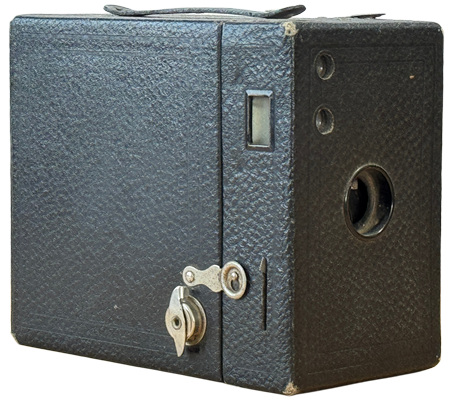
The Cartridge Hawk-Eye (1924 – 1925) was introduced by Kodak as a slightly lower priced camera. This camera was the production precursor to the the 1926 Kodak Hawkeye No. 2. #116 roll film, $3.50 new (2025 price - $63.00).
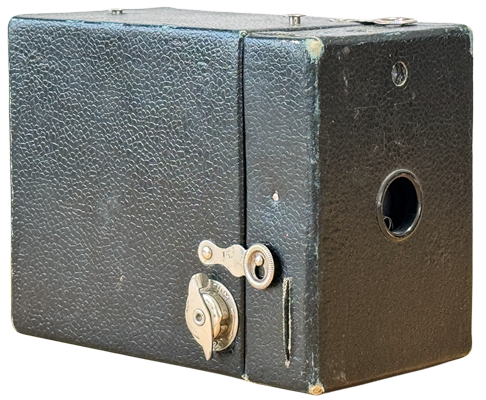
The Kodak Hawkeye No. 2 Model C (1926 – 1933) was another of Kodak’s pasteboard cameras but it did not maintain Kodak’s commitment to keeping the Hawkeye as a more economical camera. #120 roll film, $6.50 new (2025 price - $202.00)
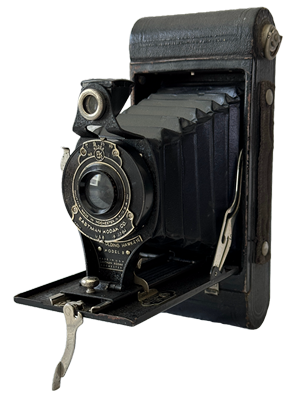
The No. 2A Folding Hawk-Eye Camera Model B (1927 – 1929) - not to be confused with the No. 2A Folding Hawk-Eye Cartridge Camera - was produced by Kodak as a “high end promotional camera” that banks would give away for opening a $25-a-Month Christmas Club (for club accounts under $25 you got a household gadget) or a furniture store would give away for buying a new bedroom set. The camera was made from the company’s existing parts stock and features a simple lens and shutter. It used #116 film producing a 2-1/2” x 4-1/4” negative. As this particular camera was never a regular Kodak catalog item the price is unknown. It appears the "promotional value" of the camera in 1927 was $3.50 to $4.00 (2025 value - $60.00 to $70.00)
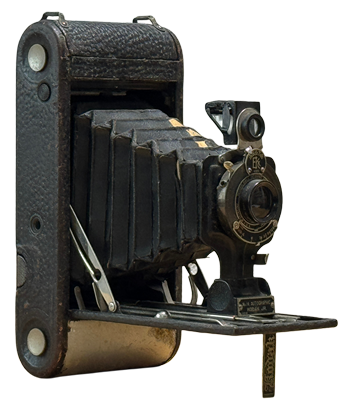
The No. 1 Pocket Kodak Autographic (1926 – 1932) is very similar to the Autographic Kodak Junior camera featuring the Autographic “window” which allowed photographers to write notes directly onto the film backing using a metal stylus. The camera also featured a rotating viewfinder for portrait or landscape work. #120 roll film, $5.00 new (2025 price - $177.00)
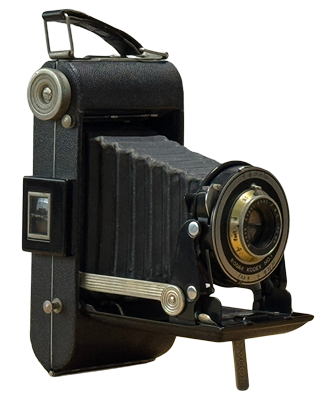
The Kodak Six-20 Junior (1933 – 1940) continued the company’s attempt to create a more compact and “pocketable” camera format. It featured a folding viewfinder on the side of the camera body. #620 roll film, $15 new (2025 price - $350.00)
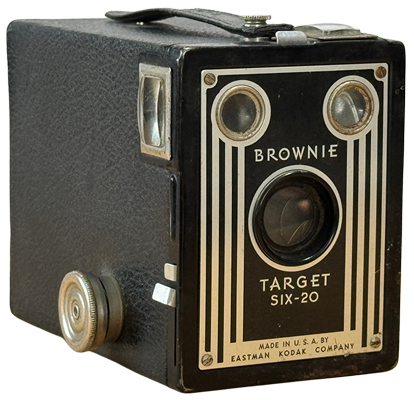
The Kodak Brownie Target Six-20 (1946 – 1952) camera used 620 film and was part of Kodak's ongoing effort to make cameras more compact while maintaining image quality. It featured a distinctive Art Deco design on the front plate. #620 roll film, $2.75 new (2025 price - $48.00)
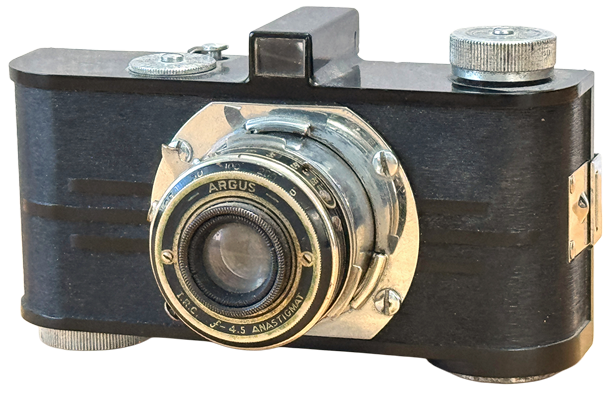
The Argus A (1936 – 1945) was one of the earliest American-made 35mm cameras introduced in 1936 and discontinued in 1941. It was an affordable camera that helped introduce the 35mm film format to the general public. 35mm film, $12.50 new (2025 price - $290.00)
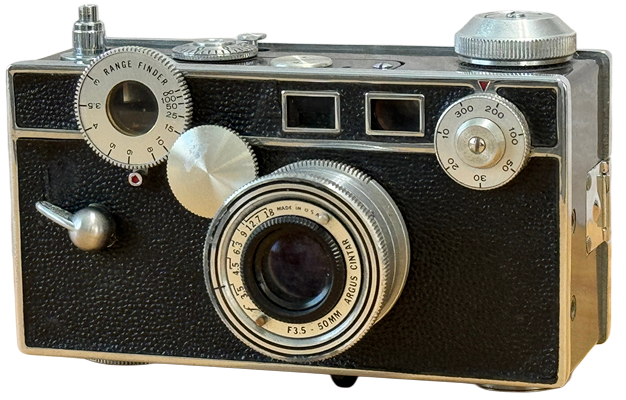
The Argus C3 "The Brick" (1939 – 1966). The camera’s nickname came from the its boxy, squared-off and surprisingly heavy design. It was one of the most popular 35mm rangefinder cameras in its day. 35Mm film, $35.00 new (2025 price - $813.00)
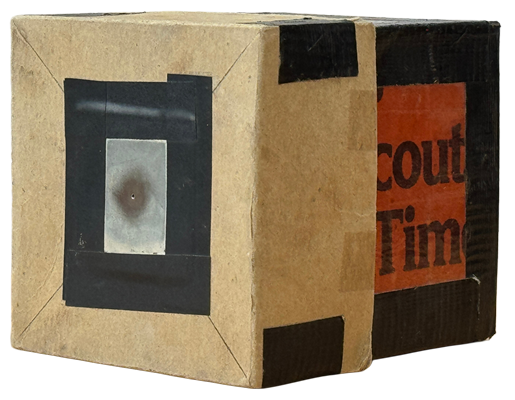
Finally, and this is on a personal note... For those of you who ever taught kids photography, this is one of the pinhole cameras I put together for the summer "College for Kids" program I taught. I made enough so the class was divided into five "teams" with them taking turns making the exposures. The "film" was a quarter sheet of polycontrast photo paper that the kids loaded through the front of the camera and the "shutter" was their finger over the "hole". They all loved the experience... taking their fingers off the hole for the right amount of time and then watching the "magic" of the photograph developing in the darkroom. In reality I don't know who learned more... them or me!